








JUBA — South Sudan’s persistent South Sudanese Pound (SSP) liquidity crunch is driven primarily by crumbling institutional confidence and uncontrolled fiscal deficits rather than a physical shortage of cash, a major new policy study has revealed.
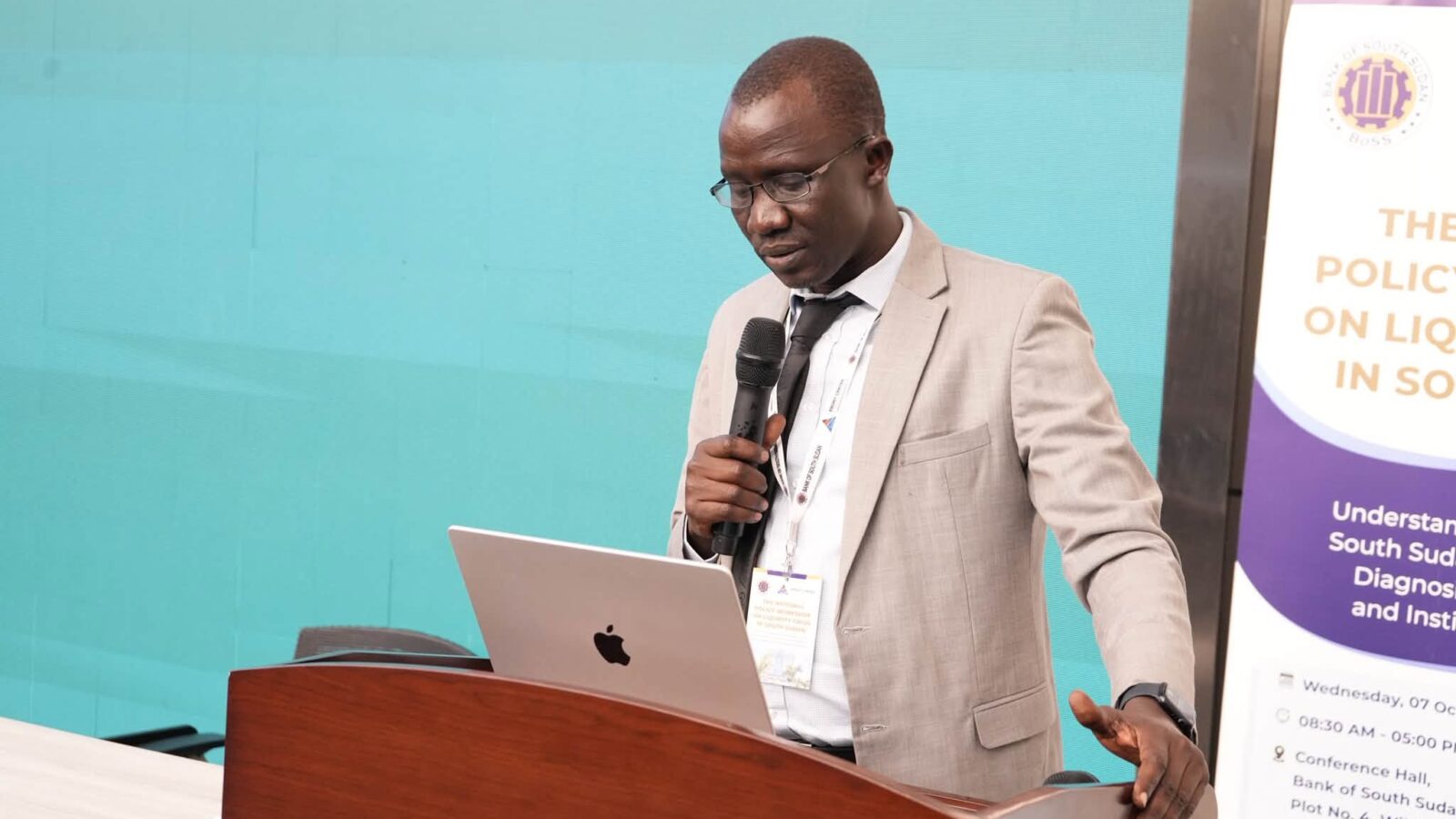
Released today by National Bureau of Statistics Director General Dr. Augustino Ting Mayai and Dr. Aweng P. Majok, the advisory note—titled Cash Everywhere, Trust Nowhere: The SSP Liquidity Crisis in South Sudan—was presented at a high-level national policy workshop organized by the Bank of South Sudan and the Ebony Center.
A Cascade of Economic Shocks
According to the study, the economic distress stems from three compounding shocks. First, the February 2024 shutdown of the Dar Blend pipeline slashed national oil production from 186,000 barrels per day down to 58,000, severely cutting state revenues.
To bridge the resulting gap, the Bank of South Sudan (BoSS) extended massive overdrafts to the Ministry of Finance and Planning, driving central bank credit to SSP 410.5 billion by June 2024 and expanding reserve money by 302% against a targeted 10%.
Compounding the crisis, unserviced government salary arrears reached between 8 to 13 months by January 2026, creating an unpaid wage liability estimated at between SSP 1.3 and 2.1 trillion. Crediting electronic accounts without corresponding physical banknotes created an unmanageable imbalance; clearing just two months of salary arrears electronically would require six times the total cash held across all commercial bank vaults nationwide.
Countermeasures Warned Against
The authors cautioned against implementing conventional quick fixes, such as currency swaps or forcing a rapid transition to digital payments.
Looking at international precedents from Kenya, India, and Nigeria, the policy note points out that currency swaps rarely capture hoarded cash, with 96% to 99% of demonetized notes ultimately returning to the system. In South Sudan—where commercial bank vault cash accounts for a mere 6% of notes in circulation—such a move would exacerbate the shortage.
Similarly, the advisory notes that an immediate nationwide digital shift is unfeasible given current infrastructure: fewer than 6% of adults own formal bank accounts, electricity access sits at just 5.4%, and mobile network coverage spans roughly 20% of the country.
Recommendations for Recovery
To stabilize the financial system and restore public trust, the advisory proposes five sequential steps:
- Halt uncovered deposit creation: Enforce a strict zero-ceiling on central bank financing for the Ministry of Finance to curb inflation at its source.
- Boost physical currency supply: Convert commercial bank reserves at BoSS into circulating banknotes and introduce a higher denomination note exceeding SSP 1,000.
- Enhance transparency: Regularly publish monthly monetary surveys, financial soundness indicators, and bank-by-bank cash distribution reports.
- Audit and reconcile obligations: Conduct independent audits of government liabilities owed to the central bank and clear outstanding balances.
- Prioritize empirical research: Support field surveys and public-private dialogues prior to launching major structural financial reforms.
The national policy workshop—convening under the theme “Understanding and Resolving South Sudan’s Liquidity Crisis: Diagnosis, Policy Options and Institutional Reforms”—brings together senior policymakers, government officials, and banking leaders in Juba to map out a coordinated recovery framework.